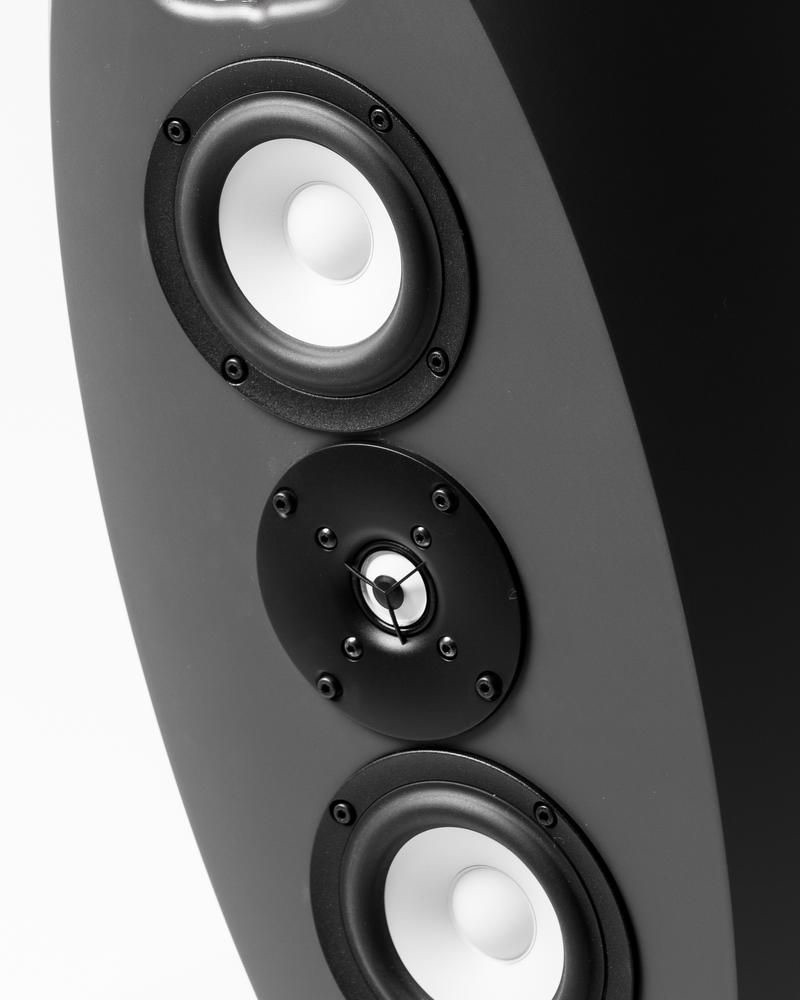
MTM arrangement
The tweeter sits between two 12 cm midrange drivers. Both radiate symmetrically around the same point, so the voice comes from a single source.
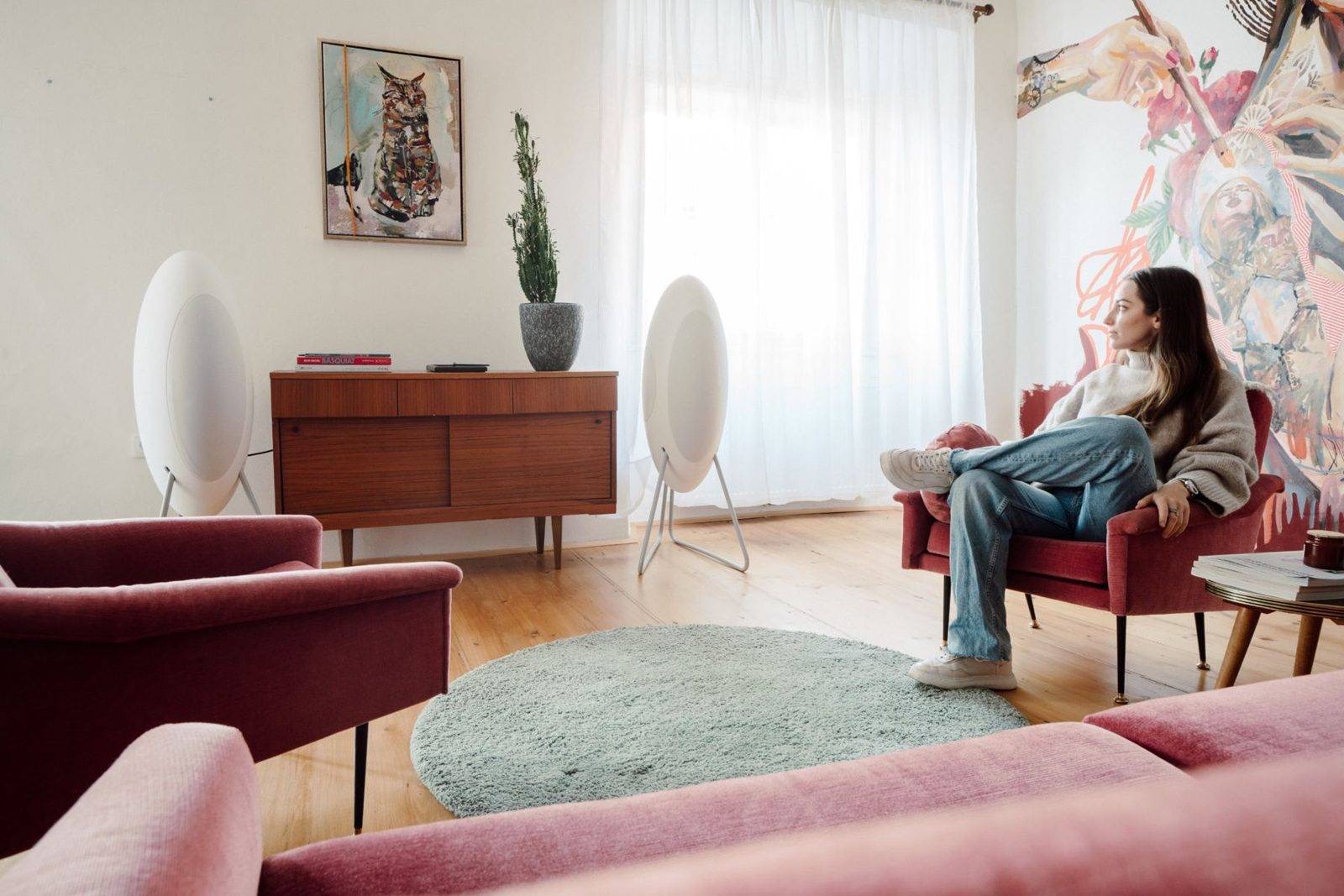
High end was built for listening rooms.You live.
With a sofa, windows and a bookshelf instead of acoustic panels. We built musegg® for exactly this room, from the woofer to the last filter.
01 · Heard
Independent hi-fi magazines have listened to and measured the musegg® high-end active speaker in depth. hifitest.de places it in the reference class with 5 out of 5 stars, Sempre Audio and HiFi-IFAs rate it outstanding.
02 · Attitude
Warm, analytical, bass-heavy: with most speakers a developer decides how your music sounds. In a listening room you will never see. For ears that are not yours.
changes over the years. No one hears quite like anyone else.
has shaped you. What has accompanied you determines how you listen today.
changes everything that reaches your ear. Every living room sounds different.
So there can be no single perfect speaker. That is why we did not build one.
Instead we built the perfect core: a speaker that colours nothing, emphasises nothing and leaves nothing out.
Only what is neutral can be shaped in any direction. A speaker with built-in character can only be bent. It always sounds a little like its developer. musegg® sounds like the recording. And, if you want, like you.
How to shape your sound: yourself with Self.Fitting or with a Sound Specialist through Remote.Fitting.
03 · HoRooc Self.Fitting
Your favourite listening spot is the reference point.
A microphone listens in your place.
A test signal shows which tones your room boosts and which it swallows.
HoRooc analyses the recording online and calculates the matching tuning.
musegg® takes over the tuning and from now on plays for your room.
Sofa, shelf, rug, large windows: every room colours the sound a little differently. HoRooc Self.Fitting comes with every musegg® and tunes it to your living room. So as much as possible of the neutral sound arrives at your listening position.
Prefer guidance? With Remote.Fitting a Sound Specialist measures with you over video call.
04 · Measured
Anyone can claim neutral. We measured it.
We sent a single tone into our electronics, 1,000 hertz. What came out: exactly that tone. No overtones that the amplifier invents. Everything else is more than 140 dB below full scale, far below what a human can hear.
Sounds unspectacular. But it is the core of everything musegg® can do: a speaker that adds nothing of its own reproduces the recording the way it was meant.
Spectrum at the amplifier output, measured with Audio Precision. Redrawn after the original measurement, 0 dB = full scale.
05 · Precision
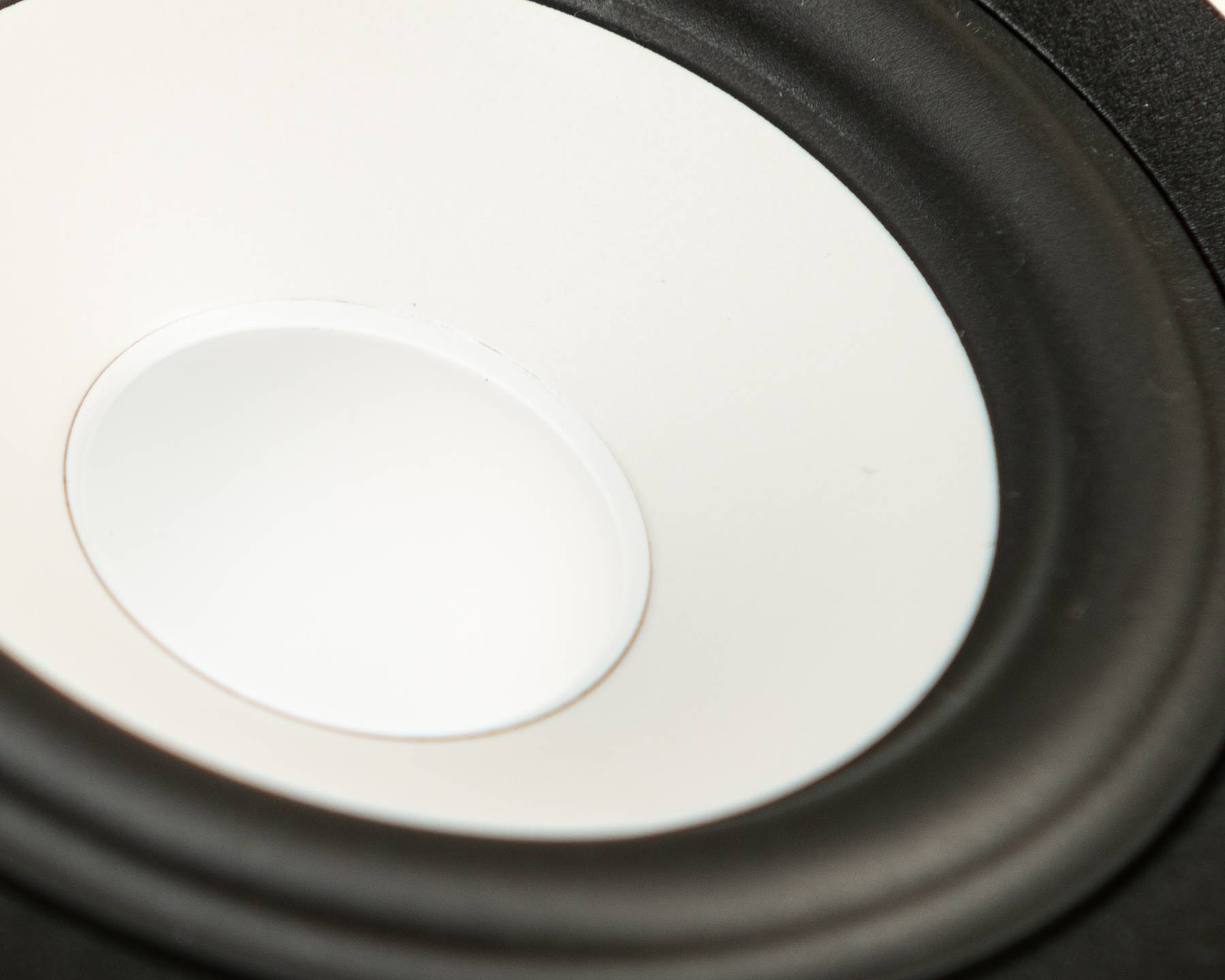
Every diaphragm has finite stiffness. When it moves back and forth, it flexes slightly within itself. At high frequencies this causes resonances, and the frequency response becomes uneven: some tones too loud, others too quiet.
That is why the tweeter and midrange drivers of musegg® use very hard aluminium-ceramic diaphragms. The harder the diaphragm, the more precisely it follows the movement the music dictates, and the further the resonances move out of the range in which it plays.
What remains is smoothed by the digital signal processor. So the resolution for the finest details is preserved, without the sound ever becoming sharp or aggressive.
06 · Bass
To create sound, a speaker has to move air. More air for more volume. And even more for a deeper tone at the same volume.
That is why every musegg® has a 29 cm woofer with a hard paper diaphragm and long excursion. It works in a bass-reflex chamber with two spiral-shaped ports, symmetrical on the front. The chamber needs no damping material at all. So no bass energy is lost, and the bass stays deep and clean, without the typical boominess of many bass-reflex speakers.
The deeper the tone, the longer the wave: at 20 Hz it measures around 17 metres, longer than almost any living room. On the right, the bass level relative to the average between 300 Hz and 5 kHz (0 dB). musegg®: measured in a 25 m² living space, average of both channels. The boost around 40 Hz comes from the room. If you set a different room size, we roughly shift this measurement to your room: larger rooms move the boost to lower tones, smaller ones to higher. How it really sounds at your place also depends on shape, furnishing and placement and only a measurement will show. Ø 16.5 cm: the same room, calculated with the bass response of a compact speaker with a 16.5 cm woofer, as measured by a trade magazine (−3 dB at 56 Hz, −6 dB at 41 Hz).
07 · Living room
Woofer towards the wall: the wall throws the bass back and colours the sound.Woofer inwards: the bass radiates towards each other, the wall stays out of the picture.
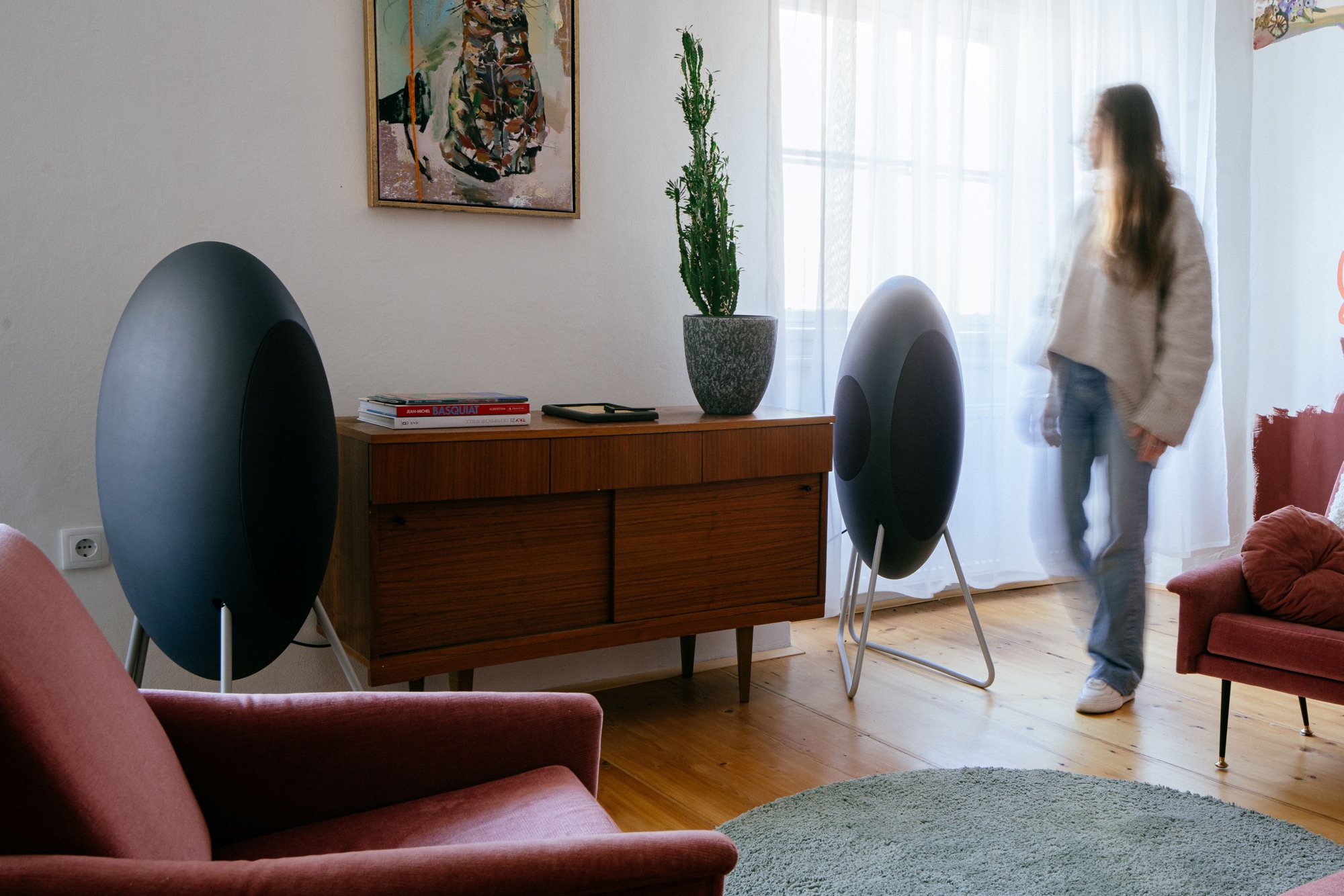
A woofer that points straight at a wall colours the sound. In a listening room you simply place the speaker far enough away. In the living room the sideboard stands there.
That is why musegg® comes as a left and a right cabinet. The woofers radiate inwards, towards each other, instead of at the nearest wall. That gives you more freedom in where you place your speakers, without the bass suffering.
And it stays with two speakers: streamer, amplifier and converter are built in. A complete hi-fi system for the living room, without a rack and without cables across the room. The Tech page shows what is inside.
How your room changes the sound and how we compensate for it is shown by Remote.Fitting.
08 · Stage
The tweeter sits between two 12 cm midrange drivers. Both radiate symmetrically around the same point, so the voice comes from a single source.
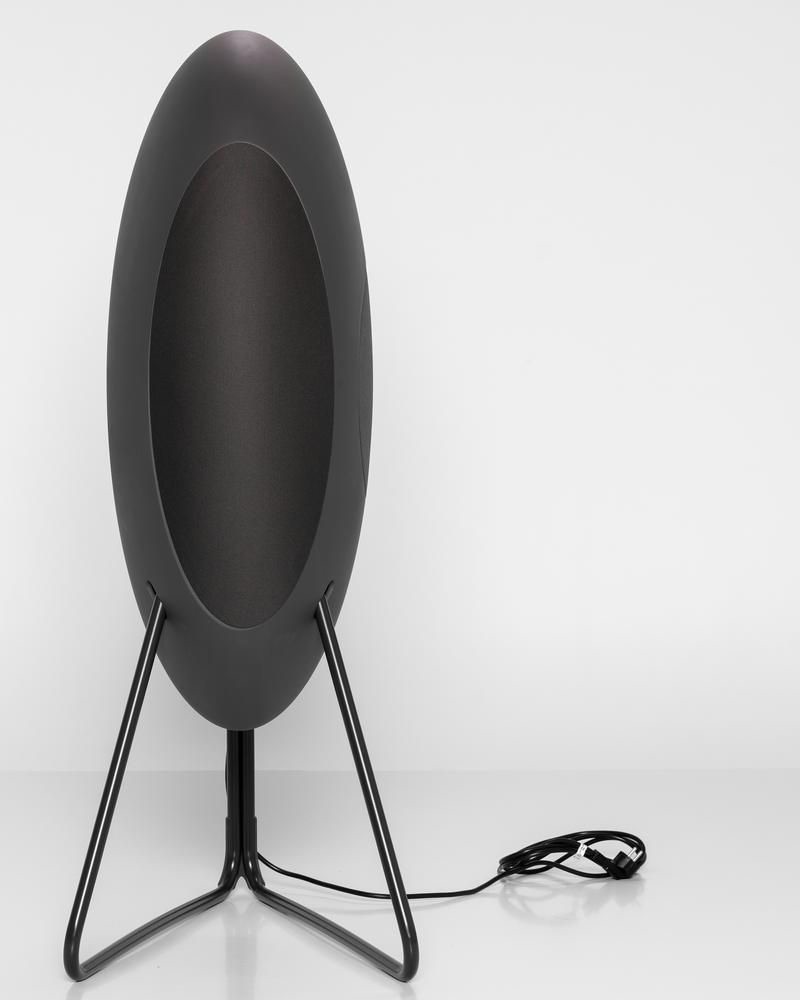
Despite the large volume the front stays narrow and irregularly shaped. That ensures even radiation and a wide stage with clearly locatable instruments.

Each midrange driver has its own closed chamber. Its funnel-like taper lets the rear sound run out instead of throwing it back as a standing wave.
09 · Chain
A system only sounds as good as its weakest link. With musegg® all links are matched to each other because they sit in one cabinet.
Each musegg® works with two ESS ES9038Q2M digital-to-analogue converters from the reference series.
Crossover, delay and filters run digitally: FIR filters with 2048 taps and 15 IIR filters per channel.
Fully active with Hypex NC2K class D modules, matched to the limits of the drivers.
25 mm dome, two 12 cm midrange drivers, 29 cm woofer.
In a passive speaker a crossover made of coils and capacitors matches the drivers to each other. Every component loses something in the process, and every fine adjustment takes a lot of effort. An active speaker separates the frequencies digitally, before the amplifier. Each driver gets its own amplifier and exactly the signal it needs.
10 · Questions
A speaker with the amplifier and crossover already built in, in a quality that keeps up with high-quality separate components. With musegg® a streamer and converter are added: two speakers replace the whole system.
Because each driver gets its own amplifier and exactly the signal it needs. The frequencies are separated digitally before they are amplified. There is no passive crossover of coils and capacitors that swallows detail.
The 29 cm woofer is designed to play down to about 20 Hz in a closed living room and down to about 30 Hz in an open living area. No additional subwoofer is needed.
Yes. The distortion is very low at all volumes, and quiet passages stay clear. musegg® is built for your favourite song, not just for the party.
The harder a diaphragm, the more precisely it follows the signal and the further its natural resonances lie outside the range in which it plays. The signal processor smooths the remaining resonances so the sound never becomes sharp.
The woofers radiate inwards, towards each other, instead of at a wall. That makes you more flexible when placing them. How your room affects the sound and how we compensate for it is shown by Remote.Fitting.
The best music system for the living room is the one that suits your room and your taste and needs little space. musegg® is a hi-fi system in two speakers: streamer, amplifier and converter are built in, you do not need a rack. That turns two speakers into the complete sound system for the living room.
Yes. musegg® is deliberately tuned neutral so that it can be adapted. You can find out how on the Remote.Fitting page.
Listen to musegg® at home. And if you want to tune it to yourself, a Sound Specialist will help you.
We use optional cookies for analytics and marketing. Choose which to allow — see our Privacy Policy for details.